
Data Science Workshops in BC and How to Get In
THE ACTIVE PROGRAMS WHERE STUDENTS TACKLE REAL PROBLEMS FROM REAL PARTNERS
If you want hands-on data science in British Columbia, the fastest way in is a workshop: a real problem, a small team and a few intense weeks. We cover the ones you can join today, who they take, and how to get in.
Workshops Running in 2026
Three programs cover most of what a student in BC would reach for. They differ in length, in who they take, and in how they are paid for, so here is the quick version before the detail.
Program | Format And Length | Who Applies | When To Apply | Cost | Where |
|---|---|---|---|---|---|
Math to Power Industry (M2PI) | Two to three weeks, online or hybrid | Grad students and recent graduates | Winter, deadline around mid-April | Funded, no fee | m2pi.ca |
Data Science for Social Good (DSSG) | 14 weeks, in person at UBC Vancouver | UBC undergrad and grad, any field | By the end of January | Paid stipend | dsi.ubc.ca |
SFU Data Fellowships | Short, part-time, live online | Students and working professionals | Rolling cohorts | Fee, scholarships available | sfu.ca/big-data |
Math to Power Industry (M2PI)
Run by the Pacific Institute for the Mathematical Sciences, M2PI is the closest current relative of the old regional workshops. It takes graduate students and recent graduates, runs for two to three weeks, and pairs each team with a live challenge from industry, government or a non-profit. The 2026 edition ran online from 25 May to 12 June, with a participant deadline in mid-April and an earlier one for organizations submitting problems. Recent projects give a sense of the range. Teams have looked at re-identification risk in health data, optimization methods for weather models, reactor-shape problems in fusion energy, and how far large language models can turn written mathematics into machine-checked proofs. The current call sits at m2pi.ca.
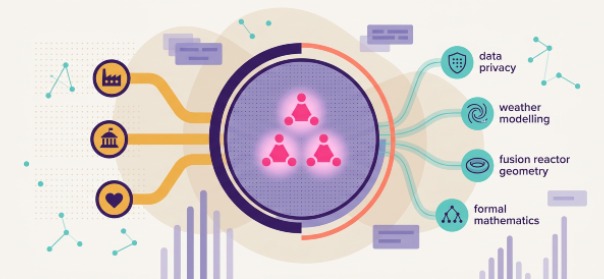
A 2026 Project in Practice
One M2PI 2026 team studied how the risk of re-identifying a person shifts inside a dataset, with a focus on children who have rare or complex medical profiles. The aim was to help researchers share health data responsibly without exposing the people inside it. Problems like this are typical of the format: narrow, real, and brought by a partner who needs the answer.
Data Science for Social Good (DSSG)
DSSG is a paid summer fellowship hosted by UBC’s Data Science Institute. It runs for fourteen weeks, from the middle of May to the middle of August, and it deliberately draws students from across the disciplines rather than from computer science alone. The 2026 cohort of eight fellows started in mid-May and worked in teams on projects submitted by local governments and non-profits, each one carrying a social angle. Applications for that year closed at the end of January, so the window opens and shuts in winter. Fellows are paid a monthly stipend for the term. The details live at dsi.ubc.ca.

SFU Data Fellowships
SFU’s Big Data Hub runs a lighter kind of workshop under the name Data Fellowships. These are short, part-time online sessions rather than a multi-week residency, and they are built for students and working professionals who want practical data science and AI skills they can use straight away. The sessions cover the machine learning pipeline, Python and Jupyter notebooks, and how to check data and models for bias. Scholarships have been offered to lower the cost, including one for women resident in British Columbia. The details are at sfu.ca/big-data.
A Few Other Ways In
Beyond the three programs above, a couple of lighter routes are worth knowing. PIMS runs a free online talk series, the M2PI Case Studies seminars, where past teams walk through what a real collaboration looked like from the inside. And both UBC and SFU place data science students with local employers through co-op, which is a slower but steadier path into applied work. Neither asks for the commitment of a full residency, so they are easy to sample first.
If Your Organization Has a Problem to Bring
If you run a team with a data question and no time to answer it, sponsoring a workshop problem is a low-risk way to get a serious look. You supply the data and a little mentor time, and a team spends weeks on it.
Both PIMS and the university programs take problems, some on a rolling basis and some once a year. The best results tend to come from a tightly scoped question with clean, shareable data, since a team of students cannot spend its first week untangling access agreements. A good problem is specific enough to finish, and open enough to stay interesting.
Questions People Ask
Do I need professional experience to take part?
Usually not. Programs look for strong quantitative skills and some coding, and several welcome students from non-STEM backgrounds. Most begin with a short bootcamp to close the gap.
Are these workshops in person or online?
It depends on the program. M2PI has run online and hybrid, UBC’s DSSG expects in-person work on the Vancouver campus, and SFU’s Data Fellowships are delivered live online.
Are they paid, or do they cost money?
The student fellowships tend to pay a stipend rather than charge a fee. Short professional workshops usually carry a fee, sometimes offset by a scholarship. Check the program page before you plan around it.
How competitive is entry?
Places are limited and admission is selective, especially for the paid fellowships. A clear application and an early submission both help.
Disclaimer
This website is an independent informational resource about data science initiatives and workshops in British Columbia. It is not affiliated with the BCData Initiative, the Pacific Institute for the Mathematical Sciences (PIMS), or the University of British Columbia.